
It’s been awhile since my last fun experiment, so I decided to start something new today. As the title implies, I’m going to be comparing Red Worms and European Nightcrawlers – specifically looking at their reproduction rates and overall composting potential.
As is often the case with my projects, this hasn’t been designed according to rigorous academic standards (by any means) – it’s really just meant as a “let’s see what happens” fun experiment.
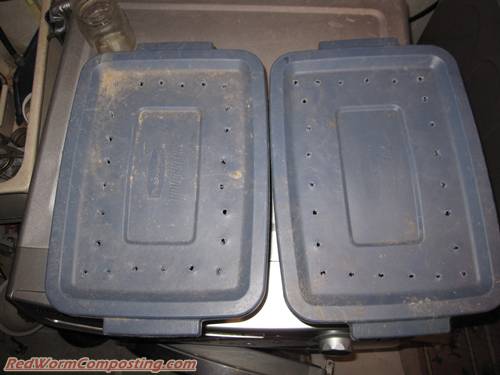
As such, I decided to simply set up two small bins – one for Euros, one for Reds. I just happened to have some food waste mixed with shredded cardboard that’s been sitting in a bin for quite a long time (had been planning to use it for a new Euro system). This was mixed with some new bedding (and further moistened) before being split between the two bins.

In some ways this is going to be like my “4 Worm Reproduction Experiment” in that I’ll be starting with a small number of worms and then tracking population growth over the course of multiple months. One difference, of course, is that we’ve now got Euros involved as well. One other change is the fact that I am starting with six worms each (not four).
Why six?
Well, aside from still wanting to keep the starting number fairly low, that just happened to be the number of adult Euros (those with visible clitellum) I was able to round up from another small bin in my basement.
This brings us to the little twist I’ve decided to add. Some of you may recall that I started with juvenile worms for my “4 Worm” challenge – the rationale being that I wanted to ensure that ALL cocoons laid in the system were the result of reproduction that had occurred in the system (adult worms can carry sperm around for some time without the need for further mating – fertilizing and dropping new cocoons all the while).
Since the consensus (academic and otherwise) is that Euros have a longer reproduction cycle, and slower growth rates, I thought it would be interesting to give them a bit of an edge out of the starting gates.
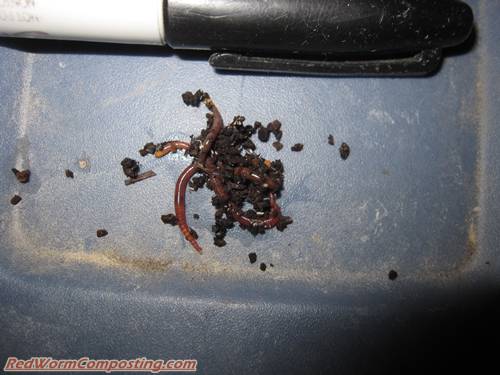
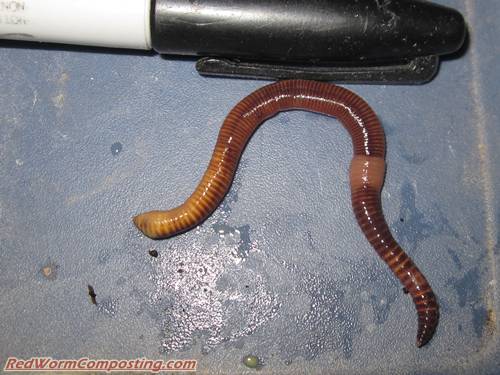
So, I added six adult Euros to one of the bins and six very young Red Worms to the other bin – as you can see below, just one of the Euros was much larger than the combined size of all the Reds!
I’m definitely looking forward to seeing how this one pans out, and feel quite optimistic that I’ll be able to see it through to completion. It’s nice and simple, with little in the way of maintenance required. I’ll basically just be checking in on things periodically, with the occasional addition of food/bedding as well (very occasionally early on I’m sure).
Should be fun!
8)
IMPORTANT UPDATE: Unfortunately, I somehow managed to kill off five of the six Euros, and potentially most of the Reds as well (need to examine that bin more closely). I’m not sure what happened, but I suspect it had something to do with the really old bedding/food mix I used. The long and the short of it is that I do plan to set up the experiment (or something similar) again – just not sure exactly when. Will keep everyone posted.
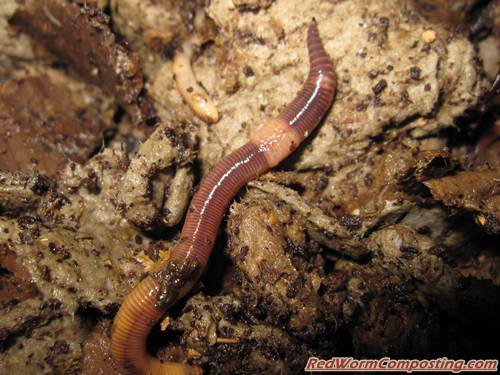
I have about 100 Euro’s and the number of coccoons is incredible. I don’t know about red wigglers but my Euro’s lay egg coccoons like crazy!
I’m still guessing as to do larger EH produce more babies due to larger cocoons?I noted 3 babies come out of a large cocoon once.But when i also noted a worms ability to go back into the cocoon i realized it is easier to watch paint dry.Lab workers got it tough in the worm world.Nice to have a makeshift lab outside.Mine just developed a skylight.Wind and worm tent..i mean lab,don’t mix!HA HA!
Gotta get me some more EH.Down here i’m thinking during breeding a EH kind of holds its own in winter.During summer they kind of throw in the towel.Cooler climates they may be breeding machines.One thing i’m guessing is in a lab it is pretty much the same temps.year round.Can’t have labs getting warm.What would temp.fluctuation do? Possibly a Euro would drop out of the race.Glad you are trying this one!I like the set ’em and forget ’em experiments myself more lately.I’m fixing to try one to see what Ag.lime means to worms wanting to eat food.Or does it mean anything at all!
I kind of feel the dice is loaded against the EF’s looking at that monster Euro. So will be rooting for the Reds (Ef’s). So … how long (time period) are we going to be watching their performance?
Larry D, would be interested in your AG Lime results as I keep threatening to add that instead of ground egg shells when I run low but haven’t quite been able to bring myself to do it. Not sure why myself?
We have found with our Euro’s that they prefer worm food over human food. Yes, they do eat kitchen waste but we have found that they do best with it buried about 1″ below the surface. We just made a trench down the center of the bed. We have a nearby mill that we have started ordering feed from and OMGosh, we have to feed our Euro’s on a daily basis because they go through it so fast. We have noticed that since we switched over from worm chow to this new (secret recipe) feed, our Euro’s are a lot fatter and definitely a lot more active. Super excited beings we can buy 500lbs of feed for about $125.
Your Euro die-off is a predictable product of a larger economic malaise. Don’t take it personally.
Bentley,you got to watch for food heating even in spots with euros.I guessed it was someones problems in the UK i think it was.Sure enough he took care of that issue and it was problem solved.They can be touchy little ladies/fellas!
Bentley, how old is/was the old bedding/food mix? I have to re-think my pre-rotting strategy here since I have way more feed than the worms can process. Yes, I’m a hoarder, LOL.
Don’t you think that RM bin is way too big for just 6 worms? My similar experiments are done in 3 gal buckets I get from a juicer place (BJ) and it’s really fun too see how big the worms got compared to the ones in the main bin.
KEVIN – I agree that Euros do seem to drop cocoons quite readily. But I think they can take a fair bit longer to hatch.
——
LARRY – I have some academic info someplace regarding the average number of young per cocoon. I seem to recall that it’s actually lower in Euros but will have to double check.
——
LAURA – don’t be fooled by the small size of those Reds. You’d be amazed by how quickly they can grow and reproduce. Hopefully I’ll get this one back on track soon so we can see!
——
TAMMY – I’ve previously had good success with food waste(and Euros). In this case it was really, really OLD stuff that had actually been allowed to dry out (for another lost experiment – lol) and then re-moistened and allowed to rot down to mush. Probably not the ideal starting mix for them!
——
DAVE – LOL
——
LARRY – These bins are very small, and the amount of starting material didn’t even fill them half way, so I have a sneaking suspicion there wasn’t much in the way of heating going on (my basement is pretty cool as well). BUT, if it turns out that the Reds actually survived (will need to do a more thorough investigation), then I will definitely go with the “touchy little ladies/fellas” theory!
🙂
—–
SUE – In all honesty, I don’t even know for sure just how long those scraps had been sitting there. As mentioned above I actually let them dehydrate completely. But even once they were mixed in with moistened bedding, I’m sure they must have sat for a good month. There wasn’t much evidence of them having been added – I’ll put it that way!
As for the bins being too big – they are actually a lot smaller than you might think. That said, there’s no reason for a larger system to create problems for a small number of worms. If anything it would help since there would be more room to spread out in etc etc.
Other than size, I’m not seeing the differences between those two varieties. Do you have more photos of each comparing them? For some reason, I was expecting the euros to be significantly different from EFs.
Hi Patrick,
These are very closely related species (both have genus name “Eisenia”). It’s not so much the visual differences that are the key but rather their life cycle, growth etc (which ARE significantly different, according to the literature).
B
Hello, Can european earthworms and red wigglers coexist in the same bin? I would like to add some european earthworms to sell to fisherman but wasn’t sure if I needed to start a new bin. Thanks, Sandy
Hi Sandra,
They CAN certainly co-exist, but I highly recommend you give them their own bin (especially given the fact that you’re aiming to raise them for bait). In my experience, Red Worms can gradually outcompete the Euros over time. Plus it will just generally be a pain when it comes time to separate them!
Thanks Bentley, I don’t want to do anything that would upset my red wigglers since I use them for composting
Thanks! I’m fascinated w/ this study of yours. It makes me wonder if I should start using Euros instead…