
April 10, 2008
Adding Egg Shells to Your Worm Bin

Someone recently asked whether or not it was ok to add egg shells to their vermicomposting systems. The question reminded me that this was something I’ve been meaning to write about for quite some time.
The answer to that question is definitely YES – egg shells are a great addition to your worm and compost bins. They are a great source of slow release calcium and can also act as a buffer, essentially helping to prevent excessively acidic conditions from developing.
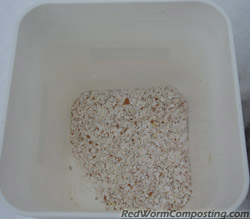
I personally prefer to grind my egg shells up as much as possible before adding them – this helps to increase the rate at which the nutrients can be utilized, and also the rate at which the obvious egg shell fragments will disappear from your bin. I also prefer to leave the yolk residues in the shells rather than rinsing them out. This provides a bit of extra nitrogen (and other nutrients I’m sure), which never hurts.
I simply put my fresh shells in old empty egg cartons, making sure not to stack any of the wet ones on top of each other so that they can dry out quickly. Once I’ve amassed a serious collection of shells, I next dump them all in a plastic bucket and grind them with the bottom of a mason jar (any hard object should work fine). You can see in the pictures above what the shells end up looking like.
I’ve read that calcium plays an important role in earthworm reproduction, so you may also see a boost in breeding if you add shells to your bins. If you don’t eat eggs, there are some other options for adding calcium. A lot of worm farmers recommend the use of lime (calcium carbonate – CaCO3) in worm beds. If used in moderation, I agree this can be a useful material, but I recommend against adding it every time you think acidic conditions are developing (as a ‘quick fix’). You may end up throwing the balance of your system off kilter and harming your worms in the process. Composting worms are actually very tolerant of acidic conditions – apparently Red Worms in particular have a pH tolerance range of between 5 and 9, according to Dr. Clive Edwards (renowned vermicomposting researcher).
Rock dust may be a better choice than lime simply because it will likely be a little more slow release (like egg shells), and can contain other beneficial minerals as well.
**For Even More Worm Fun, Sign Up for the RWC E-mail List!**