
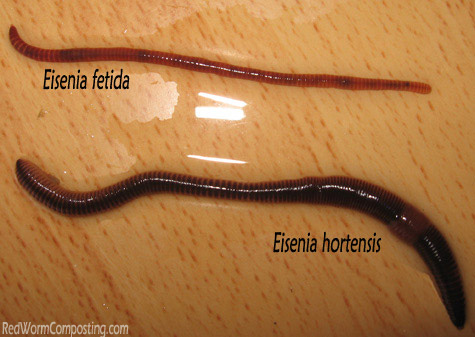
My new worms arrived today and needless to say I am very excited – almost excited as when I received my first batch of red worms (many moons ago now). I’ve never seen a ‘Euro’ before (aside from photos), and was surprised by just how different they look from my red wigglers. Aside from the obvious size difference, they seem to be much more of a brown colour, but still display the distinct banded pattern typically seen in Eisenia worms.

Given the quantity of worms a received (likely close to a 1 lb) I decided to split them between the two aged bins I set up for my worm composting videos. I had originally planned to start my “4 worm experinment” in one of them, but I’ll start a new one for that. It has been about a month and a half since I set up the bins, so much of the food waste is very well decomposed and not even recognizable – I have little doubt that the microbial population is quite rich (certainly lots of visible fungal mycelia). Moisture seems to be well balanced in the bins, but a little on the dry side so I made sure to add some more water. When I checked back on the worms after letting them sit for a bit they seemed to be exploring their new surroundings quite readily (definitely a good sign – they came in a decent amount of bedding, so they would have stayed in it had the bin conditions not been to their liking).
I received the worms as a thank-you gift from my worm farmer friend, Jeff. I’m in the process of helping him set up a website for his business (and will certainly provide more info once it’s ready for visitors). Jeff was kind enough to send the worms via priority post, and made sure to label the box well. The postal delivery lady seemed to get a real kick out of saying “enjoy your worms”, as she handed me the package! Oh, the things we worm fanatics have to put up with – I tell ya!!!
😆
Some More European Nightcrawler Info
As mentioned, Euros are a larger cousin of the red wiggler. They are also known as ‘Belgian Nightcrawlers’, ‘Euros’, and ENCs for short. Another very common scientific name is Dendrobena veneta – this is what they were referred to prior to the change over to Eisenia hortensis. The former name is still used extensively in Europe.
Due to their larger size, Euros make an ideal bait worm. I’ve got such a soft spot for worms these days that I can’t imagine putting one on a hook anymore (and I’m a pretty avid fisherman), but I can definitely see how they would be ideal based on their size alone – they are significantly bigger than a red worm, but smaller than a ‘dew worm’ (‘Canadian Nightcrawler’ – Lumbricus terrestris), which are often TOO big. I’ve read that they are incredibly durable on a hook even in very cold and brackish waters – thus making them a very versatile bait.
As composting worms, research seems to indicate that they are not as ideally suited for the task as Eisenia fetida. They have a lower rate of reproduction and take considerably longer to mature. That being said, I’ve been told they can be more tolerant of poor bin conditions and low food levels – more apt to stay put as compared to red worms.
I will certainly be very interested to test them out for myself to see what they are capable of, and of course will continue to share my findings here on the blog!
**For Even More Worm Fun, Sign Up for the RWC E-mail List!**
Hi Bentley
Yes that euro is very dark, this bunch of euros were harvested out of bedding that was well used up, I think you will start to see them get a bit lighter in colour as they start to eat your new feed stock.
This is a great pic..
Jeff
Thanks for the info, Jeff!
I’ll be interested to see how their appearance changes now that they are no longer eating manure.
I’ll be sure to post more pictures as well!
8)
I have a bin of ENCs and they seem to like manure allot more than food scraps.
The red worm doesn’t seem to be a mature worm. No visible Clitellum.
Hi Vermiman!
Thanks for the ENC info. I will be interested to see how mine respond to scraps. So far so good – they seem to be eagerly feeding on the materials I’ve added, but then again they don’t have any other options. I will be interested to see if they shrink in size (manure is typically a more nutritious food source). I have witnessed this shrinkage with red worms previously living in aged manure.
You are definitely right about the red worm in the picture – I guess that’s not the best comparison shot. I’ll definitely be taking some more (will be putting together a photo gallery).
B.
Would like to know where to buy these worms,im ready to go fidhing.
Hey Chuck,
Send me an email and I will help you track down a European Nightcrawler supplier.
Hello Jeff,
Love the picture showing the two types of worms. Any chance we could use it on our website (with credit to you of course).
Thanks,
Leo, Pat And Mark
http://www.wormsatwork.com
Hi Leo,
It’s actually my image (I am owner of this site – Jeff is a friend), but you are more than welcome to use it with proper credit given. I will send you an email.
Thanks
Bentley
Hi Bentley,
I enjoy your postings a lot. I live in British Columbia, Canada right next to a horse farm. I have access to all of the horse and turkey manure that I want and would like to try and grow Euro’s commercially. Were you sucessful at breeding your Euro’s? I would like to learn from your experiences. Please contact me on my email address to discuss further.
Thanks,
Steve
Hi Steve,
I have yet to be successful breeding Euros on a large scale. They are definitely not as fast to grow and reproduce as Red Worms are. I will be working closely with them this winter to see how quickly I can increase my population, and will certainly write more about that.
You should have success with them, having access to all that manure. Just make sure there aren’t naturally occurring Red Worms in there since they may end up outcompeting your Euros.
Hi Bentley,
I’m new to this, and I’ve been hoping to breed Euros, but where i live, there are very few if any euros that i can seem to find. I find lotss of other kinds of worms idk what any of them really are though. I was wondering if you had any suggestions to breeding them as rapidly as possible. or if i could be able to find more where i live. the soil is sand and clay and dirt of course.
Thanks, Jonny
hi,
i have been looking at thi s site for a reference for quite some time, even before i started my worm bin. you have given me so much help with my bin. My worms are breeding and they all wiggle in my hands. i have european nightcrawler by the way not red wigglers. i wanted to know how to fatten up worms but they got fat by themselves. i think it was because of and w/your help my worm bin is a succes.
Thanks, T Money
Well thanks, T Money! I appreciate the kind words, and am always happy to hear that I have helped someone with their vermicomposting efforts!
8)
How cold can they survive. They are in a storage building and no heat. there home is 2′ by 3′ bins card board bedding and coffee grounds. Also what do you feed them for the increased size.
i have a problem with my enc a few puff up as thick as your little fingerthen die . they are in old horse manure mixed with peat moss with a ph of 6.5 and ifeed them fresh sheep manure on top and they are covered with a sheet of card board.there are aprox 100 to 2sq ft can you help me please.
DAN – very sorry for the lengthy delay. They should be able to tolerate temps close to (or even at) the freezing mark. BUT it’s important to realize that growth, reproduction, composting ability etc will slow down a great deal at lower temps. To fatten them up you might try something like “chicken laying mash” (or general poultry feed) containing a decent protein content. Manures seems to work well also.
—————–
ROB – The only thing I can imagine is some sort of nitrogen poisoning due to the fresh sheep manure. Try aging it first before adding it
hi, great website! my son is raising euros to sell as bait. my big question is what about high temperatures? they’re in our garage now and it’s really getting hot here! any suggestions?
thanx so much – God bless,
martha
Pingback: Raising Red Wiggler Worms as Fishing Worms
I started growing euros In a 2’x4’x2′ outside bin this summer here in Eastern NC with 1lb worms.Had lot of trouble keeping them cool but we made it.I feed nothing but veggie I get from dumpster at store.When temps got below 25 I had to but heating pad on top of a wet towel over the food.By Chistmas I had start another bin I have so many babies(thousannds) it is crazy.I am hoping to sell some mainly forr fishing but have no idea how to start any suggestions?
I came across your page as i was researching the idea of small scale worm farming for fishing bait…
I think i have the basic idea, and a sorta of plan … is there a supplier in south eastern Ontario?
ohh and Bently, your sand box garden made me smile.. great job
bently
night crawlers are good tillers unlike red worms they distribute the manure produced by red worms in a farm land , they are organic tractors.it help farm lands to get tilled and act as aerator agents for the soil , dont put it in a box it will die dear.
Hi Rafeeq,
The term “nightcrawlers” can refer to man y different species of worms, so it’s important to be clear on what scientific species you are referring to in particular. European Nightcrawlers (Eisenia hortensis), while perhaps a bit more of a “soil worm” than Reds, they are certainly NOT soil tillers – and they can indeed do very well in box systems. Canadian Nightcrawlers (Lumbricus terrestris) on the other hand are much closer to what you’re describing (and indeed, they will not do well in a composting bin).
Hi Bentley,
I have been checking out Eisenida Hortensis and am not clear about how long they live. Some info I got makes it seem like they only live for about one year. What is the truth about this? I am looking for a worm I can raise, and then put out in the garden. Is Hortensis the best choice? Common field worms might be better, but can the be propagated. My land seems to be quite worm poor.
Thanks for you help.
Hi Ruby – hard to say for sure how long they live. I haven’t come across any info in the literature. Red Worms can live multiple years in captivity, and generally less when out in the “wild”. I wouldn’t be surprised if Euros live longer – they tend to be a bit more of a “slower” worm (lower reproduction rates etc), so this would make sense.
Euros might be BETTER as a soil worm than Reds, but I still wouldn’t say they are ideal for that application – unless you have a really rich, loose soil. You might consider, instead, the idea of creating an in situ vermicomposting system like a trench or worm tower.
Would like to begin construction on a large housing bin in the hope of raising and breeding Canadian Night Crawlers. My brother and I reside in Massachusetts. Hoping you can share some advise on the three most imperative things I will have to implement in order to be successful. This includes The bin itself, ideal temps to maintain, feeding and care of worms. Would be using the castings for floral shop and vegetable garden and also attempt to market and sell to local fisherman. Hope you will take an interest and share some knowledge.
Thankyou
Hi Richard,
Unfortunately, Canadian Nightcrawlers are NOT a good worm to try and raise in captivity. They need a deep soil habitat and a lot of space. If you want to raise a large worm for bait my recommendation would be the European Nightcrawler – a composting species.
I have around 1300 Europeans, but they are small. How or what do I need to do to get them big and fat? Thanks for all your help.
I am getting into the worm growing with European night crawlers and red wigglar. I have 8 fiber glass tray that are about 1 foot in depth and maybe 6×8 I am using horse manure for bedding started out with about 2lbs of worm no they seam to be multiplying it but the ENC don’t seam to be getting very fat they are about the same size as reds and the color is darker and the acidity is 6.5 moisture is good . Ideal growing conditions they just want get fat . I have feed them everything from chops to crushed corn and oats they love the oats but they are not getting fat .
Does anyone have any suggestion on what I need to do . Thanks in advance
Hi;
I love this website. I have been growing red worms for a month now and I only started with 24 of them…They are doing great. I am excited.
Thank you for all who contribute educating me about composting.
In searching new info I found your site and the next hour was spent reading. Great info that I was exactly looking for! I am just starting up but am very interested in the Hortensia (ENC). If you could pass along any suppliers / farms selling them please inform me as I WANT some. I put you in my favorites so I can be visiting your site to read all that I can absorb..
Not sure my first attempt posted. I am looking for a photo of hatchlings of eisenia hortensis. I am wanting to confirm that I have a massive hatch and not an infestation of some sort.
Sorry for the delay, Ed! A massive hatch of anything is (unfortunately) a decent indicator of some sort of infestation. Not necessarily a “bad” thing, but usually indicates you are making conditions favorable for other organisms to really get established. If I had to just guess I would say maybe pot worms. There are times when lots of little (composting) worms CAN hatch at once – example when cold material that has lots of cocoons in it is moved to a warm location (or outdoor beds in spring as they warm up) – but for a typical home bin this is not what’s going on.
I just recently got some from Walmart. Wanted to find “Red Wiggler’s” but didn’t know what aisle they were held. Luckily some dame who looks like that chick from that 70s show Helped me out. They were in a container labeled American BigRedWorm and DMF. Thanks for clearing things up because I wasn’t confident if they were as good as Wiggler’s.
Just became over stocked with eisenia hortensis being disposed of by local fishing store.
I would like to keep these worms and was wondering if they can be used in a worm farm?
Hey Mick – if they are Eisenia worms they can definitely be used for worm composting/farming. Euros do tend to be a lot more sensitive than Red Worms (be careful with vibrations) but they are great worms.
European earthworm Eisenida hortensis, as the name suggests, hortensis = “garden” will be perfect for your home gardens and farms. It is a surface worm with a very high resistance to frost, much greater than the Californian earthworm Eisenia Fetida and Eisenia Andrei due to the cold climate prevailing in Europe. Although it is less fertile than the above-mentioned species, in spring almost all specimens will overwinter and are capable of creating a new biohumus in your gardens no worse than Esenia Fetida or Andrea
I’ve found E fetida/andrei to be very cold tolerant. And I’ve also found E hortensis to be similar in terms of thriving mainly in really rich habitats. None of these composting species have ever really become established in my regular gardens (even though I’ve had big outdoor worm beds/bins for years). I think there can be a fair bit of variability from location to location, though.