
Here is a question from Lynette re: the critters she has been finding in her worm bin:
I’d love to see photos of pests so I know what I have and if
they are a problem. I had 1/4-1/2″ segmented critters in there during
the summer and now I have a bunch of tiny white things busily going
all over. I tried to pick the first ones up (there would be chunks of
them happily eating on something). These white things are newer and
there are now fewer of those larger wormy bugs and a definite
reduction in worms. We had a hot summer in Texas and these have been
shaded on the patio, not too dry, I’m sure. What has happened?
Hi Lynette,
It is very common to encounter other creatures, aside from worms, in your worm bin. For the most part, they will be at worst an annoyance – i.e. there aren’t too many that will actually directly harm your worms.
When new critters appear in great abundance it is usually just an indication that favorable conditions (for them) have developed and/or there is plenty of food available. The shift in conditions can sometimes have a negative impact on the worms, causing them to die off or leave (if possible) – making it look as though the new critter is directly responsible for the disappearance of the worms.
Your wormy, segmented organisms sound like soldier fly larvae to me. They tend to be very common when bins sit outside in warmer regions.
Your tiny, white critters are almost certainly either springtails (first image below – brown ‘bug’ in that picture is actually a mite) or mites (lower image is a close-up shot of a common type of worm bin mite).

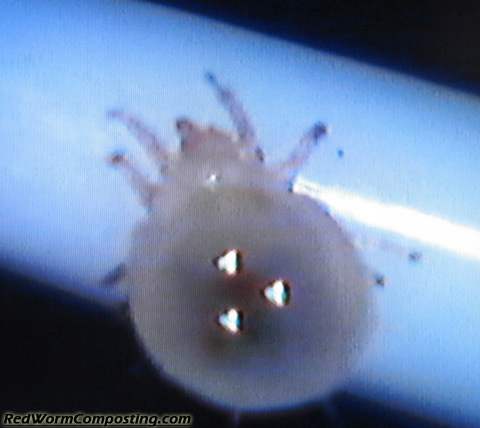
Worm bins kept outside are far more likely to be invaded by a wide range of other creatures, since the system will be much closer to their habitat (ie they won’t have to get into your house first). Both springtails and mites (most of them anyway) are totally harmless to worms, but may compete with them for food. Again, I suspect that your reduction in worms has been brought about by a shift in the conditions inside the bin – perhaps the hot Texas summer is responsible. Hard to say for sure though (at least without being able to see the system myself, that is).
Hope this helps a little!
8)
Lynette,
Like Bentley, I couldn’t be sure without seeing them, but I live about 30 miles west of Clovis, New Mexico (If you’re in Texas you may know where that is.) and we may have pests in common. I’ve never seen a springtail or a mite in my tubs but I’ve been feeding a lot of apple peelings and melon rinds and from time to time get heavy infestations of fruit flies. When this happens I start finding “little white things” about 1/16″ to 1/8″ long, segmented, which I have identified as fruit fly larvae. (Miniature maggots.) Neither the larvae nor the fruit flies are harmful but the fruit flies can be very annoying. Just another possibility.
John
hi,
i heard that moist bread in your wormery will attract the white things, you can then take the bread out and feed it to the birds. i had a problem with ants this summer.
I too have a lot of tiny white bugs in my worm bin. They crawl (quickly) all over the place, in all of the layers. They are about the size of a knat or noseum(sp?). They are flourishing and taking over my bin!Any ideas of how to reduce their numbers?
Hi,
I also have a new worm bin and recently discovered white mites. My question is in regards to my other pets. I have reptiles and a frog. I plan to feed some of the worms to them. Can I cross contaminate and get a mite infestation with my pets?
JOHN – thanks for chiming in. Fruit fly (or even fungus gnat) larvae are a possibility that didn’t even come to mind.
———
MGB9 – the creatures you are referring to are ‘White Worms’ (aka ‘Pot Worms’) and can indeed be found in a worm composting system, so that could be another possibility. While you certainly may attract these worms to where the bread is sitting, be careful – they will also start breeding VERY quickly. These little guys are a common food for aquarium hobbyists and the ‘milk-soaked-bread’ (or even just water-moistened) method apparently works very well. Anything starchy that goes sour, really – my first experience with a white worm explosion was in my very first worm bin. I added a huge amount of cooked rice and ended up with more white worms than you could probably count in a lifetime! (haha) They were coming out of the air holes and everything!
——–
STEPHANIE – Hard to say for sure what you might be seeing. I would need to see a good close-up unfortunately.
——–
AMELIA – Compost bin mites are not parasitic. They are specialized for the composting environment, not living on a pet
I have had 3 large red wiggler die-offs. The only thing I see possibly wrong in the bins is a white, bacteria-like worm, thinner than fine thread, and not segmented. They move like worms and multiply amazingly fast. I find them feeding on everything, including the dead wigglers. They prefer the soil close to the top. and they climb up the sides and onto the undersides of the bin lids. I cannot get rid of them. What are they?? One morning the Wigglers seem fine and then several hours later the top of the soil looks like red spaghetti. They are all trying to get out, and most are dead, on top on the soil . HELP!
This is a BAD problem. One commonly misdiagnosed as mites and spring tails. The small critters are called Symphylan. They are soil-inhabiting arthropods. The thrive on decaying matter and worst of all small root systems. They destroy more crops than all other pests combined **according to what I’ve read**.
If transplanted to a garden bed they will effect you plants! In soil, they almost always go unnoticed. One may find only ten-fifteen in a shovel full of dirt. They are very hard to spot. However, a worm bin is a perfect breeding ground for them. Constant supply of decaying matter, perfect temperature, and no predators. Best thing for a small worm bin is to remove all the worms. Rinse the worms thoroughly in a strainer. They will easily rinse off of the worms. Freeze the worm bedding and soil. The re-introduce your worms. Hope that helps.
Hi NWGardener,
While I certainly appreciate you sharing this info on symphylans, I think it is important not to jump to any conclusions here. I assume you are responding specifically to Morris’ comment?
A non segmented worm (or at least one that appears to be) that moves like a worm and multiplies incredibly fast is very likely a pot worm (aka white worm). They tend to thrive in bins that have gone “sour”, often due to overfeeding – so that could help to explain why the worms are not happy.
I would love to learn more about (and perhaps more importantly, see photos of) worm bins that have been taken over by symphs. This is news to me.
my “white things” look like dots. No larger than the tip of a straight pin. They cover a grape I have in the bin as well as other rotting vegetation. If I look very hard I can see a movement of one of these things. I cannot describe them as a worm but I am wondering if the worm cocoons move?
Those are almost certainly white mites, Anne. Worm cocoons are larger and more straw colored than white. Worm cocoons also do not move.
I have thousands and thousands of tiny white mite like things in all of my bins (four layers of Worm Factory). I knew they were in the top layer, but found them also in the bottom one when I just went in to remove some compost for a little planting project with my daughter. I’m afraid to remove them from the bin and use them with this houseplant that will be in the kitchen because I’m afraid they’ll hatch into flies or fruitflies or something. Can I use the compost when they’re crawling in it? Will they disappear once they’re not in the bin anymore?
thank you Bentley for your reply to my millions of tiny white dots in my worm bin. So do these mites affect the compost when transferring into pots or a beds for planting? I never put any grains, bread, fats or dairy products into my bin. Where do the mites come from?
I have the teeny tiny things also. I have read many revues and forums only getting information for mites. These are not mites. Mites are a bit bigger and also can be seen very well by the unaided eye. I have better than perfect vision and have no idea if they are segmented or not. Tomorrow I am placing my bin in the sunlight and removing food that is contaminated. In addition, the finished compost is being pushed to one side while new barely wet paper is added to the opposite side. I am going to try and lure them out with cantaloupe rinds over the next few weeks every day. It is a very annoying problem as I also jar noticed my worms looking a bit sickly from not getting enough food.
LYNN / ANNE – these mites are adapted for life in compost ecosystems – not so much in finished compost and/or typical plant growing environments. There are an unbelievable number of different mite species in the world – and the ones you find in your worm bin are generally scavengers, detritivores etc – definitely not plant parasites or anything like that.
————–
BLAIR – Better than perfect vision? Wow – I’m jealous. hehe
One other white critter that is VERY common is the springtail – as with mites, these really aren’t anything to worry about
Well, I still have the little white things. They seem reduced after I took the lid off an moved my compost to one side. I added new bedding and spray it at least four times a day to keep it from drying out. My worms, though less in number, seem alright. I buried some food for them and am patiently waiting for the white things to go away. Leaving the lid off seems to help. The worms are living deeper in the soil and the white guys don’t seem to be in control any longer. They are smaller than the hole of my smallest sewing needle, yet before they were almost covering the top of the soil. It is time to harvest my compost, I am afraid, though since the last time I tried to lure my worms out, I ended up with these little critters. I fear I am losing my worms at a rapid rate and wonder what action should be taken now to save my dwindling population. Does anyone really know what they are? If there are any ideas, please send them my way. I am so saddened by this, it’s almost funny. Guess you have to be a vermi-composter also to understand…
Hi Blair,
I’d ease off on the feeding and leave the lid off for periods of time each day. I’m pretty sure you either have mites or springtails. A good way to find out if it’s the latter is to pour a small amount of water into some of the compost/bedding – if a LOT of them suddenly appear on the surface there is a pretty good chance they are springtails (they don’t like really wet conditions – whereas the mites thrive in wet bins).
B
I removed all my worms from the bin yesterday and washed them with tepid water in a sink. I quickly replaced them into a new bin that had been filled with brand new bedding that I bought at a bait shop yesterday. The bedding looks a lot like the newspaper stuff they use for insulating in attics. I dampened it like the directions said and I covered the plastic tote with a dark towel and placed it in a dark cool bathroom. I was told they will eat the bedding but I added some corn meal and coffee grounds for grit and tonight I checked on them and they are loving their new home w/o the tiny white mites. Yea!
I have these tiny white creatures also. They came with the worms, as my bin is only a month old. Should I be worried, as there is no definitive answer as to what these creatures are. They are on the lid of the bin and the sides and seem to love the cardboard. Should I just start all over? The bin is in the garage which is attached to the house so how did they get there?
Wormer – definitely NO need to be worried!
Not sure I have EVER had a worm bin that didn’t end up with white mites in it (and all my current worm bins also have springtails in them). While I can’t
provide you with a “definitive” answer without seeing them myself, I am almost 100% positive your white critters will be one of these two invertebrates.
Absolutely (PLEASE) do not start over! Very important to remember that there is an entire compost ecosystem at work here – not just worms! Many of these critters simply come (often in form of eggs or young) with the worms – totally normal and nothing to be worried about.
🙂
So what happens to these mites and creatures when its time to harvest? Do they die off or do they migrate to something else. I have my worm bin on the porch where I also have potted plants.
Hi Rox,
A fair number of them likely end up in the finished material – although, if you let your system sit for a couple of weeks (no feeding etc) and/or dump the material and let it dry some, quite a few of them should vanish.
When the material is actually used, the vast majority of the critters will end up dying off I suspect – their ideal living conditions are in a moist composting system.
I have just found loads of tiny white things in my bird food bin. There is a sack of wild bird seed and one of chick crumb in there and when I opened the lid, they were everywhere. I am going to clean the bin out but I also found them in the food so just wanted to make sure they are not going to be harmful to the wild birds or my chickens, or should I throw it all away? please help 🙂
i have tiny tiny red bugs about the size maybe smaller than a mustard seed. what are they,can i get rid of them,and how
I’ve been reading this thread about the various other creatures tagging along with worms when they are delivered. I’m just starting out and plan to keep my bin in the garage–hopefully without a lot of troublesome “other” inhabitants in the bin. Should I rinse my new worms when they arrive?
My worm bin has become absolutely over-loaded with tiny white thread-like worms.
When I harvested last time I tried to bring as few as possible along when I transferred the worm herd to their new bin. This time I did the ‘easy’ harvest and let the worms migrate on their own to the new bin. Tons of the tiny white worms have managed to show up there already.
What are they? Do I need to be concerned about them?
Blessings…
I have the extremely small tiny white bugs also but my bin is indoors. I have cats and fish. Should I be worried?
I also have these tiny white bugs in my bin. They seem to be in the bottom tub more then in the main tray with the worms. When I disturb the thin layer of soil that they are crawling around (very fast) they seem to jump an inch or more in the air.
I have been doing some research and reading all of these comments. I believe what I have is an infestation of springtails. They are so small, though, that it is hard to tell by the descriptions I read. My biggest problem is that I live in the mountains and simply cannot have my worm bin in the garage at this time of the year. It is too cold. Consequently, I have it in the house and the bugs are driving me crazy. There is a constant supply of fresh “whatever-they-are” on the floor surrounding my bin. They look like tiny greyish black specks against my natural colored tile. But if I look closely, many of them are moving. I continue to vacuum them up (perhaps I should mop with a disinfectant instead?), but they just won’t go away. I’m guessing that the teeny-tiny white things flourishing in my bin are just an early form of these greyish bugs? Funnily enough, when I went hiking the other day, I saw these exact same bugs covering the snow where I was hiking… upon research, they’ve been called “snow bugs”, but I think that’s the same thing as springtails. ??
In addition, there are flying (albeit very SLOW flying; easy to squash with your thumb when they land on the wall) insects. I need to open my bin to add food (obviously), but ever time I do, I let out another supply of these annoying pests. I WISH I could keep this bin outside… any suggestions? Bentley, I read your newsletters all the time and would love to hear from you. Thank you for all that you do for us worm people. 🙂
I have the same thing, millions of those little white things. the only thing that works is cover bed with cloth so the bed can breath , up off the bottom a few inches, completely sealed so those little fly’s cant get in or out,the’ll die if they cant get out
I have found another way to cut down the population of those little white things is to expose my bin under the bushes where all my friendly geckos & lizards are living. They love those little white critters and will jump down to gulp on them. Of course , I place the bin (without cover) out there after 30 minutes when all of the worms already dive down deep into the soil & squirt a couple times to keep the surface moist. My friendly geckos finish the feast in 15 minutes max. I also have fun watching them enjoying their treat.
Hi everyone I am reading about these bugs or mites..but not a lot of suggestions on what we should do? Or does anuthing need to be done.. so I just started with worm faftory 360 and its been 3 weeks..everything was going fine and today I came home and mites and fruit flies or vinegar flies ..I got rid of flys and made sure food was burried more but the mites are out of control thru the soil well on top..I just need help please on what to do if I should do anything..and will they hurt my dog..I know some mites are bad for dogs..please help and Iam about to start over and I came so far ..thanku in advance
My infestation or whatever it was went away on it’s own, righted itself, as most things tend to do. I’d seriously doubt there would be any reason for concern for dogs or other pets.
billions of these tiny white “microbes” (for lack of better unknowing word) over here. Kind if distressing to learn they come with the worm bags. And no recommendation as what to do about it/them. Never seen them before, and worry now about moving ‘invested compost” into our garden fearing plant destruction and further infestation.
I accept that if there’s nothing to worry about, then there must equally be a way to rid them. Since I have read a total of ZERO comments that they are indeed a benefit to the ecosystem at work.
Much appreciate any thoughts.
Gary – there is no need to be distressed. They are part of the ecosystem just like the worms are, so it makes sense that they would come with them. Without all these other critters, including the actual microbes (which are invisible), vermicomposting could not take place. So yes, they are definitely beneficial.
If you have loads and loads of them it could be an indication that there is too much food in there.
As for getting rid of them – should you insist on doing so, it seems that diatomaceous earth when used in moderation can help to reduce the population of critters while not harming the worms. I have not worked with it myself, but hope to do a small experiment at some point.
when I went out last spring to scoop up some old leaves to add to the worm bin, I apparently introduced some new creatures as well.
Can’t find descriptions of them in any online worm grower websites.
1. little dark, black beetles, about 1/8 to 1/4 inch long. They go for the new food scraps before it has broken down enough for worms and seem to tolerate more heat. They don’t end up in the leachate and move fast.
2. Little white segmented critters, perhaps larva-like, but they move faster than, for example, fruit fly larva. About 1/8-1/4 inch, with a tiny dark spot at the head end. They curl up and raise their heads up to look around when disturbed. They tolerate more cold and moisture than the worms, and often end up in the leachate, where they dry up in quantities in the summer. Possibly the larva stage of #1? They sometimes hitch rides when the worms move around, but they don’t appear to bother the worms. They are freely distributed in the worm castings in the lower bins as well as upper, so I assume they are part of the compost process.
3. Little fly-like creatures that look like two very skinny long fruitflies connected head to tail, black with gray in the middle, about 3/8-1/2 inch long. They sometimes crawl out or maybe fly. Haven’t seen as many of them as I used to, now that I am managing to keep the temperature and other conditions regulated.
Rosi,
Your questions 2 and 3 sound like BSF (Black Sokdier Fly and their larvae). Especially the fly-like w/ gray segments. They are harmless, and the adult (fly) doesn’t have any mouth parts and cannot feed. They only live for a few days, mate, lay eggs and die. They don’t feed or deficate, therefore do not carry/pass germs or disease. Also once they’re established, houseflys are history.Their larvae are fast moving and can reduce garbage faster than worms and can eat almost anything. Some areas actively propagate them to reduce their garbage dumps. Also red worms LOVE the grub-reduced waste.
If you’re in a warm climate you could have them year-round. Bottom line, they’re good for the worms and the environment.
Can U add pics of these please?
I have those tiny little white critters in my worm been. What is the best way to get rid of them. I only see them by the food area so far. Are they bad for the worms? Thank you in advance for any help you can give me.
Hi Charleen
Do not worry too much about the little white critters (likely springtails). They are not bad for the worms. They are basically performing the same function as the worms, and if anything they should help.
Loads of mites (round, shiny and slow moving) may indicate that your bin is too wet and not getting enough air flow. Can also be a sign that you are overfeeding and/or not optimizing the food for the worms.