
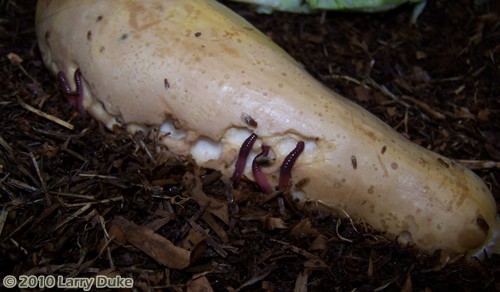
I wish I was an Oscar Mayer weiner,
But I’m def-in-ite-ly glad I’m not a squash!
😆
A BIG thanks to Larry D. for sending along this crazy (creepy) picture of Blue Worms (Perionyx excavatus) feasting on a squash in his bin. I’ve actually been meaning to write more about these worms for quite some time now but…well…you know the drill. (lol)
Here is what Larry had to say about the picture:
This picture is of PE’s eating a squash. Some people get confused as to worms not having teeth means they can’t eat solid food. These PE’s will create suction somehow. When their head goes real blunt-looking, they snatch off a piece of squash. This picture is taken during the day with my bin open outside in the shade. They love the surface, and don’t let indirect light discourage them from a good meal. You can tell by the groove they made, they like squash.
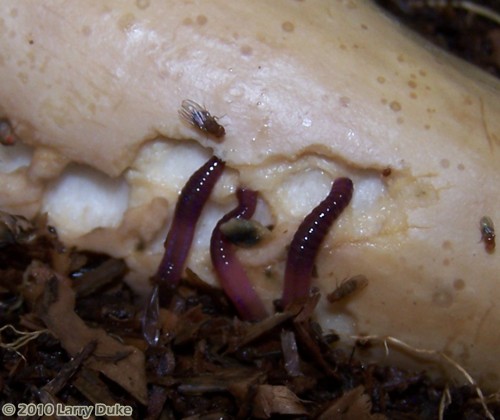
I’ve played around with this species for long enough (several months) to reach the conclusion that I’m not a fan. Let’s just say that I won’t be starting up the website “Blue Worm Composting” any time soon! – they just give me the willies (haha), and they also tend to have a temperamental streak. They move like lightning, and don’t seem to be nearly as put off by light as Reds (especially when they are feeling unsettled). I’ve actually read cases of them being found up in trees and on top of tall buildings (not to mention traveling long distances) during rainy weather, and certainly witnessed some pretty kooky behavior myself.
If you want a worm that can quickly (and effectively) process waste materials, though, Blue Worms are top notch (the pictures say it all). Some of you (long-time followers) may recall the interview I did with Dennis Copson (Nature’s Big Bud). He only uses Blues (after switching over from Red Worms) and swears by them!
The KEY requirement, however, is warmth! These worms will drop like flies once temps get down below 10 C (50 F) or so – helping to explain why I no longer have them!
{insert evil laugh}
As you can see in the pics, one of the distinguishing features of Blue Worms (also called “Malaysian Blue Worms” and “Indian Blue Worms”) is the blue/purple sheen. Larry’s specimens seem to exhibit this quite nicely. In my experience, they can look a fair amount like Reds at times (or at least a bit duller in color) so it’s best to rely on some of their others morphological features and characteristics. One of their nicknames is “Spike Tails” – when I first heard this I had visions of little sharp spines sticking out from their tails, viciously slashing innocent vermicomposter fingers if they came too close (wouldn’t put it past them!!! lol), but I came to realize that this is more than likely due to the spike shape of their body. They tend to be thin and pointy in comparison to some of the other main composting worms. Another key feature is the location of their clitellum – up very close to their mouth, as compared to Reds (further back, with thickened head region).
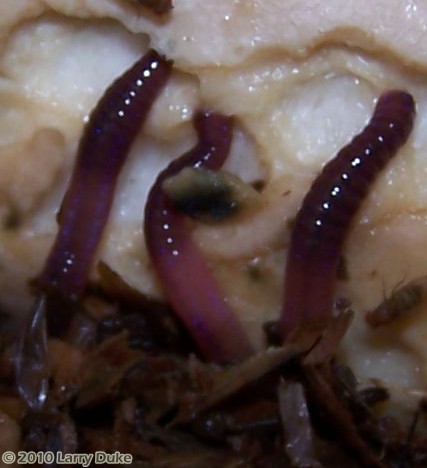
The movement of Blue Worms tends to be unique (and CREEPY) – apart from moving incredibly quickly it almost has an “inch worm” quality about it – mostly concentrated up in the anterior end (Reds seem to use more of their body).
Blue Worms have become something of a worm farming “pest worm” over the years. During hot weather they can sometimes invade Red Worm beds and expand their numbers quite quickly. As such, it’s not all that uncommon to end up with some in your Red Worm systems – what can be really frustrating, though, is the fact that some suppliers out there seem to have no qualms about selling “Red Worm” cultures that are almost entirely Blue Worms. Not so bad if you live in a warm location and are happy to create some worm compost – but pretty depressing if you live in a cooler location and end up with a dead worm population once the mercury starts to dip!
By the way, I happened to find one of Larry’s videos on YouTube today while looking for interesting footage for this post. Here is a vid demonstrating what can happen as a result of rainy weather.
Speaking of rainy weather – this is another interesting topic on its own. Blue Worms aren’t the only ones that seem keen to roam during wet weather. I’ve seen plenty of Reds doing this as well. Is it moisture? Is it the drop in pressure? Hmmm….we’ll have to explore that topic at some point!
Anyway – enough of an eyeball-full for now. Thanks again to Larry for the pic (and the video).
😎
Great photographs!
During hurricane Igor I witnessed, what I refer to as, “The Great Escape” of reds from my (then singular) indoor bin – similar to what’s shown in Larry’s YouTube presentation. Worms everywhere! Never happened before or since. I gathered the weather stats and noted that there was an unusually significant change in atmospheric pressure within a relatively short period of time – which I considered possibly relevant. Bentley suggested that it was a staged revolt over my lack of wiggler culinary skills .. and .. I admit .. that’s also possible.
You said,
Blue Worms aren’t the only ones that seem keen to roam during wet weather. I’ve seen plenty of Reds doing this as well. Is it moisture? Is it the drop in pressure?
My reds try to climb from their Worm Inn when I overwater. I’d say it’s the moisture they’re escaping. When things dry out they return to the bed. It’s teaching me to be sparing with the water.
Tom, it looks like Larry’s worms are indoors, so I don’t think moisture is the only thing that gets them going.
The only thing that’s gotten my blues going is to many carbs in the bin with the resultant overheating. I have a small flow through, so they were escaping from the top and the bottom!
If these worms were shorter,i believe they would move just like an inch worm.It even gives me a creepy sensation.I call them freaky worms.If you spray the bedding with water,it starts twitching all over.Wierd when you see the bedding trying to slide sideways.The babies will jump right out of your hand!
If you look at the picture closely,you can see how wet i keep the bedding in my flowthru.I also have EF’s in there,that feed a little lower than PE’s like to feed.My EF’s love it wet.But in a tub,you could have issues.Flowthrus are all about air.The water doesn’t bother PE’s when i spray it.But a strong thunder storm can be a whole different story.These are in an open tent garage structure.It keeps sun and rain off only.Temperature is the same as outside,because it is also under shade trees.
They are a little funny about being messed with.You could have a bin set up wrong,and put in say 5000 worms.And wake up,and only have 400 left! But they make real good composters if you can keep them alive where you live.The small castings has a whole different feel than EF’s.
If you ever try these worms,make sure to keep a light on them until they get settled in.Even then,you may get some wanderers.
But they reproduce at the most amazing pace i have seen.A few,becomes many quickly!No telling how many i have.But it is a bunch.They love grits and rice too!
Bentley–when I saw the first picture on this post, I thought it was an arm. Now THAT really is scary!
I unwittingly came to own my blue worms. By the time I figured out what I had, there were virtually no EF left in my worm bin. I’ve put them into my hot compost (usually around 130°F-140°F) and find this to be a perfect spot for them. They do very well with the warm temperatures and their numbers are still growing. At the same time, I have found them in lots of spots around my yard, so I try to keep them a long, long way away from my EF bin.
GRITS! Now I know Larry is a true southerner or do you buy the grits because of peer pressure and give them to the worms?
I won’t eat grits
in the bowl they sits
only with worms they are a hit
(17)
Anna-good idea for halloween.Creepy pants.flannel shirt.squash arms.rotten lettuce head…Look on a tricker treaters face…..Priceless!
Mark-I got southern worms.
Hey Mark–here in Wisconsin, they think that people from Kansas are Southerners. So, your grits comment made me smile.
Anna (a Kansas native)
Recently I discovered one of my worm providers had Blues, So I quickly Shut them Down, but after I noticed the Blues work Well In My Doggie Poo Bins, they seem to thrive in there will keep you updated.
I saw a video somewhere that showed a scene with fast food.Cups and all going into the dumpster.Something is telling me to try these worms on those food chains.I am building up a collection of the disposable products.I will be doing various experiments on the cups,wrappers,foil lined paper,etc.It is a start.Not sure who to talk to if we discover a way to reduce this type stuff.I will be using 4 species of worms.Too bad i got this idea close to winter.But no doubt i will have a load of trash come spring.I am a redworm type guy! But who cares the worm if we can reduce from fast food chains.It may not even work! BSFL can polish off the hamburger patties!
I go through 30lbs of vegetable waste a day.feeding my rabbits with the green trimmings and other things the market calls waste.they also get rabbit pellets .I have 50 rabbits at 4lbs/to 14lbs average .my blue worms are kept in different containers under the rabbit cages. rain or shine they keep eating all the time.I cover them with cardboard or burlap keeping them wet or damp.also use compost to deter flies.
Where can I get some of these blue worms ?
That picture also looked like an arm to me! I actually did a double take!
Better do a sneak peek before opening the lid for kids to see, should I ever venture into owning blues!
Just check prices so they don’t cost you an arm and a leg! HAHAHAHAHA!
They look simular to Africans to me, I said simular. anyway I have come to certain points like many, If it works for composting it is good, If it works realy good, even better. I had read simular peices on Africans, years ago like the 70s, and had been scared of them, now I love them, they are the best composting and bait worm I have ever found, in the winter in Ga, I have no problem with them in my raised beds. they just go deaper, and I cover them with straw, till spring.
i just reveived my 2000 “RED WIGGLER” order from a well known supplier (that ships in a sack with a string)… not to mention names. i was wondering why those worms were so lively after being in the mail for 2 days. they was bouncing like alabama jumpers in my hand lol. when i shined the light on them they ALL had a blue-purple shine to them. they eat like crazy but that’s not what i ordered and payed for. my replacement shipment should arive next wednesday and i hope it will contain 2000 EF.
Hi I am new to this site, I would like to know has anyone got a method for making African Nightcrawlers bigger? It is just that I really need bigger ones if I am going to sell worms for fishing and composting, thanks.
-Jones
I’m about to start an aquaponic system and can tell you that the worms can be used in an aquatic bio-filter. What the worms are running from is the lack of oxygen.
The ones in the video weren’t running from lack of oxygen.If PE get unsettled,they’ll be all over the place.Spray a bin down with water,and they’ll head for high ground at times.I water my bins in the morning.Do it right before dark,and you will see worms leaving completely open systems.I’ve had PE live in a pool of water for months.But weather fronts are a different matter.
Are these the same blue worms I dig out the swamp here in southern south carolina
Hi Andrew,
These are almost certainly not the same “blue worms” – that is why use of only common names can end up getting confusing. I wouldn’t be surprised if there are various types of “blue worms” out there – but there will only ever be one Perionyx excavatus (well not counting any sub-species those kooky scientists might happen to come up with – haha)
i definitely recommend blue worms if you live in the more wetter areas i have mine in a compost pile the seem to be all over the place in my backyard but they always seem to end up back in the compost
Question. ….I’m in talks with an Amazonian outfit in Peru discussing the possibility of setting up a worm farm in a tribal village, with the hopes of their utilizing the compost and teas for vegetable production and self-sufficiency through more sustainable farming practices. My concern is over species selection as it relates to the higher temperatures experienced in the Amazon. Outside of Iquitos, in the Loreto area, temps are fairly steady year round in the mid-90’s, with lows in the 70’s. Anyone with experience with this species believe that Perionyx excavatus would handle mid to upper 90’s full time? Thanks in advance.
According to the literature I’ve read, EFs can stand up to 95 F (35C) and PEs can stand up to 86 F, (30C). I’m in Hawaii in a rain forest south of Hilo on the island of Hawaii and it does get up to the 90s sometimes but not frequently, I haven’t seen any problems with our mixed herd of PEs and EFs.
Below is some info I’ve gleaned from the web about both species that may help. North American’s don’t like PEs because they die in the winter, however, PEs reproduce more quickly and therefore compost more overall even though they’re smaller and compost less individually. I highly suggest you test both before recommending. I worked for a decade in community development, esp. public health, and getting it wrong the first time can be devastating to the possibility of having your project continue. (‘We tried that and they all died’ – no understanding that this is a different kind of worm.)
Eisenia Fetida
Reproductive rate: Approximately 10 young per worm per week under ideal conditions.
Average number of young per cocoon: Approximately 3.
Time to emergence from the cocoon: Approximately 30-75 days under ideal conditions. (Edwards and Dominguez say 18-26 days)
Time to sexual maturity from birth: 53 to 76 days (E and D say 21-30)
Time from cocoon to maturity: Approximately 85-150 days under ideal conditions. (Edwards and Dominguez say 45-51)
From a website in south africa
incubation period of cocoon = ± 25 days?Birth to sexual maturity = ± 65 days
Dominguez says the best temp for reproduction is 25C, which is 77F. They tolerate 0C to 35 C (32F to 95F).
Hungary http://www.ecology.kee.hu/pdf/0302_051059.pdf birth to clitellum 21 days, birth to first cocoon production, 28 days.
J.M. Venter and A.J. Reinecke – cocoon incubation 23 days, birth to maturity 40-60 days.
Survival – up to 5 years
The earthworm population doubling time is about 60-90 days. From the “Reuse of Sludge & Wastewater residuals” by Alice Outwater, p. 118.
Colorado State – doubling time 4 months.
PE Maximum reproduction under ideal condtions:
19.5 cocoons per adult per week
90.7% hatching success rate
1.1 hatchlings per cocoon
Net reproduction of 19.4 young per adult per week
Maximum growth rate under ideal conditions:
16-21 days to cocoon hatch (E and D say 18)
29-55 days from birth to sexual maturity (E and D say 28-42)
45-76 days from cocoon to maturity (E and D say 40-71)
For the PE owners reading this, they say 25(77) is also best for reproduction and that they tolerate 9C to 30C – 48F to 86F.
To maximize reproduction, Initial stocking densities greater than 2.5 kg/m2 (0.5 lb/ft2) surface area but not more than 5 kg/m2 (1.0 lb/ft2). It is possible to get worm densities up to as much as 20 kg/m2 or 4 lbs per square foot
initial stocking density greater than a half pound (500 worms) per sq. foot surface area but not more than a pound per sq foot (1000 worms). You wait and split the herd when the population reaches 2 pounds per sq foot.
Susan, thank you much for your great reply. It seems that the only thing to do is to start small, as the temperatures can push the higher end of the worm’s liking in this region. I have experience with Ef, and believe that they would probably make it alright under these conditions. We’ll see. Thanks again.
I started out with European nightcrawlers a year ago but had a lot of problems getting them through the winter last year. Come March, I had 3 bins with a pound of worms in each. By October I had about 1600 pounds of worm. Further investigation showed that they were Alabama Jumpers which are a lot like the blue worm if not the same. The reproduction was so fast that the adults did not get much size due to competing with the young. There are about 8000 worms to a pound of bed run worms. I figured mass doubling time to be about 12 days but I think if they were split up more frequently, the time could be cut in half as the adults could gain much more weight than when left with the young worms. Nearest I could tell, the cocoon stage was about 10 days.
The bins were made 8 inches deep and never got closer than an inch from the top. Most of the summer, I turned the lights out and hardly lost a worm. I did see a lot of what is in the video but they always went back into the bin when the lights were turned on.
Now that cold weather is setting in, the worms are heading downward the best way they can. My solution is to put them in windrows until spring.
I think this is the worm of choice for composting during the summer. They multiply much faster then redworms and eat more as well. I think most of our Alabama Jumpers came with the cow manure and compost that I got locally(Oklahoma).
Here in asia, blue worms grow up to ard 15cm lol.
Well, maybe it’s because its rheir native country. Strangely, you cant find any of them nowadays, in the wild, in Malaysia & singapore.
I read varying reports. That red wrigglers consume more & faster than blue worms, some say otherwise. So guys, please share your findings. Friend and i are deciding which to get.
Our local weather’s like,
Heavy rain every altwrnate quarter,
Tropical rain forest,
Avg 32 degree celcius.