
Here is a question from Geri (**I’ve also provided an audio response at the end**):
I am new at worm compost and I have noticed a lot of little
white insects in my trays–are they harmful and what are they?
Hi Geri,
There are a number of possibilities here – first and foremost however, let me assure you that these critters are definitely NOT any sort of lice. The only type of ‘lice’ you might find in a compost bin are ‘Woodlice’ (a.k.a. ‘Sow Bugs’, ‘Pill Bugs’, ‘Basketball Bugs’) and they are not really lice. Heck, they’re not even insects for that matter (they are crustaceans – much more closely related to crabs and shrimp than bugs).
In my mind there are two main possibilities in terms of what you are finding in your bin: 1) Springtails and 2) Mites
Springtails
Formerly thought of as a prehistoric insect group, I’ve just learned from Wikipedia that these creatures are no longer actually considered insects at all. Regardless, they are a very common invertebrate found in compost heaps and worm bins (among numerous other habitats). As the name implies, they usually have a spring-like tail appendage known as a ‘fercula’, but interestingly enough some of the common varieties found in composting environments don’t seem to have these.

Springtails, like composting worms, feed heavily on microbes – especially various types of fungi – so they are generally beneficial in a composting system. Some people claim that they can irritate the worms when very abundant, but I personally don’t worry too much about their presence my my own systems at all. In fact, they really seem to help break down waste materials – and in particular, seem to be a valuable asset in terms of keeping fungal populations in check (so less likely to see molds etc taking over your bin), and for taking care of wastes that the worms might not be as eager to feed on (such as citrus, and structurally resistant materials like broccoli etc).
Mites
There can be a huge array of different mite species – even within single compost ecosystem environment. One of the more common varieties found in worm bins is what I refer to as a ‘white mite’ (I am still not sure if this is one species, or a number of similar species). People often assume these are ‘eggs’ – in fact many vermicomposting newcomers wonder if they are ‘worm eggs’ – since they are white, shiny, round, and don’t appear to move at all. If you watch them for long enough however (or use a magnifying class) you will realize that they do indeed move, and that they possess a short set of appendages to assist with their locomotion.

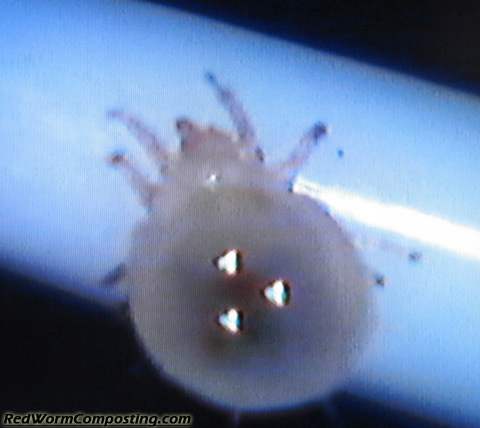
As is the case with springtails, the presence of these critters in your worm bin in itself is definitely nothing to be concerned about. If you are seeing massive quantities of them however (coating the sides and underside of lid – perhaps even coming out of the bin) then it may indicate that you need to make some adjustments so as to better optimize conditions for the worms. In my experience, mites (and these mites in particular) really thrive is wet conditions where lots of excess food is available. They also seem to do well in acidic environments – quite some time ago, I wrote about how one of my bins (fed too much bokashi waste) went ‘sour’, and one of the symptoms was a huge abundance of these mites.
People often assume that these mites actually attack and feed on worms since quite a few can sometimes be found on the worms themselves. Based on my own experiences with this phenomenon, I feel that yes, they do sometimes feed on worms – but in every single case, I’ve observed that the worms were either dead or dying. I suspect, therefore, that these mites serve as general scavengers in worm bins, performing a valuable clean-up role when the need arises. This is yet another reason to keep your eyes open for these white mite population explosions – they can sometimes indicate that something is going wrong with your worm population (likely due to environmental conditions in the system).
If you want to learn a bit more about mites in general, you may want to check out this blog post I wrote: ‘A Mite is a Mite is a Mite? Not Quite!‘
Anyway, Geri – I hope this helps! If you still think your white critters might be something else, please do provide some additional details and we’ll see if we can further narrow down the possibilities.
😎
**For Even More Worm Fun, Sign Up for the RWC E-mail List!**
I took a real close at my new bin, I have noticed alot of different bugs.
After doing some research, I found those different bugs are not harmful (in small doses). When all the food, fungi, bugs, and worms are added up, I concluded that my worm bin is an eco-system.
OK, so after reading this post and your newsletter of January 8, 2010, I am sure that I have Springtails. Just today I noticed quite a lot of them in certain spots of my bin. Your advice leads me to not be very alarmed, except that today when I opened my bin (just before I found the Springtails) I found lots of worms on top of the castings; usually they are happily beneath the surface.
I wonder if the two are related, i.e. the Springtails are increasing in number and my worms don’t like them, or if there is a second cause for my worms all being on top of the surface, like being too wet or the pH being off. I have had my bin for about 6 months, and I have never seen the worms congregate on the surface as they were today.
I’d appreciate any thoughts you might have; I’d hate for my worms to be unhappy!
Thanks very much,
Dave
Hi Dave,
I’ve had loads of springtails in my systems and have never seen anything like what you’ve described, so I suspect that something else might be causing the issue with the worms. This MAY be an indication that you need to freshen up the bedding or start up a new bin entirely.
Thanks for the comment, by the way – it reminded me about a post I’ve been meaning to write!
8)
Okay, so this photo (the lower one) is kind of confusing. The larger, slightly golden, ovoid balls ARE worm eggs, right? And then the smaller, white circular things are mites, right?
Gosh, I hope so, because I’ve been sifting by hand through my finished compost (which all the hatched worms left, heading down through a punctured sheet of black plastic into new bedding), but the eggs! the eggs! I can’t stand to kill the babies off by planting them later on in the six-packs with my spring bedding plants.
Thanks for all your great info!
Oops, I meant the upper photo, not the lower one (which is clear as day).
Hi Lee,
I assume you are talking about the broccoli slice with mites on it? I’m not sure what “slightly larger” objects you are referring to, but everything on there is a mite. Worm cocoons are a lot bigger than that.
I am so pleased to find this article because I have been trying to identify the minute white bugs in my worm farm. I came up with Collembola/springtails.
When I collect the worm pee millions of them form rafts floating on top and I am not sure if I should be tipping them onto my vegetables? Will they do any harm or do they just die?
On a similar note, I recently got lice. I realized this after I had started my bin (at one point I covered it with a washcloth to keep light out but have better ventilation until I cant cut holes. Also, I shred a lot of paper and cardboard yesterday right before I found out- do I have to toss it? What should I do?
I’m glad I found this! Just started worm composting a week ago and now see a couple worms on the side of the bin covered with white mites. I’ll assume they’re dying, or at least not too healthy. I may have too much food in the mix, so I’ll start my adjustments there. Thanks!
Hi, Bentley. I have tiny white critters in my bin. I seem to see them in the lid, because the lid is black and the critters are white. They’re probably elsewhere, too. They move super fast. Does that indicate they’re springtails rather than mites? I don’t see a ton of them or anything. I’ve added some more bedding just to make sure it’s not a moisture problem.
Hi there, I’ve just noticed a plethora of mites on my middle tray…other than making adjustments for moisture (this middle bin was quite moist) is there anything I should do? Like wipe the mites at least off the sides of the tray? And for the moisture, just dry bedding, should that be alright? Thanks, newby at this!
Hello People,
Maybe someone can help me! I have just read a number of posts on this site and to my surprise have found that the critters that are in
my hair and coming out of my skin pores look identical to the picture
at the top left. I was exposed to these critters via a negligent landlord and now have springtail larva and mite eggs in my nose ears and skin. I trekked them into my car via my shoes and they got into
the a/c vent system. When I turned on the a/c in the convertible I inhaled these suckers and they are now in my system. I wish I were delusional because this is a nightmare. They are congregating in my bowel and throat where the food stays until digested and eliminated.
Please help. What kills springtails and mites??? Please help!
MARY-JANE – I PROMISE you that the critters in your hair are not the same thing as would be found in a worm bin. Lots of little “critters” look similar to those not trained in invertebrate identification.
My guess is that you are dealing with some sort of head lice – whatever the case may be, I definitely recommend getting in touch with a trained medical professional rather than trying to figure out some sort of critter-killing home remedy!
I’m so grateful for all this info! I too have those lil white things. I do feel better now. When I first saw them (last week I almost dumped my bin) I was sooooo disappointed. I’m new too red wiggler worm composting and figured I blew it. I think its too moist and too many tomatoes!
Thanks mate, very informative and helpful!
I too have little white crawlers. Which from the picture are surely Springtails.(Thank you for picture and info).I’m so glad to hear they don’t cause damage! I started my worm farm about 9 months ago and really enjoy taking care of them.They seem to be very happy and boy do I have way more then I started with.
Thank you. I was worried they were a sign of problems.
OMG your such a life saver!!! I was freaking out man!! I just got my european night crawlers about 3 weeks ago. I put them in two bins and keep them under my kitchen cabinates to help protect them from this winter cold. However, the nights get cold under there even though it does not come close to freezing. I have noticed i have lost a worm here and there. Then all of a sudden this morning I found these white “eggs” all over some dead worms!!! I immediatly thought internal parasite and quickly became concerned for the health of my two small children. Upon research we discovered these were indeed the little white mites. Whew!!! It got into the teens last night and i forgot to pull the bins out and set them on my table to be sure they didnt chill. Im assuming now that the worms died from the cold (all of them were close to the walls of the bin) and the mites are eating them.
Thank you so much for this awesome information on these little critters!!! My worms will be moved into the room and covered with a blanket to protect from any cold at all now. The worms are thriving!! After only 3 weeks i have huge active worms and egg cases every where!!!!
Thanks again for helping us newbies understand a little more of this miniature working echosystem!!!!
Glad to help, Rachel!