
Or SSUBWHT, if you prefer!
😆
Likely the biggest pain in the rear for new vermicomposters – apart from fruit flies and fungus gnats – would be harvesting vermicompost from a mature worm bin.
As you may recall, I am quite interested in DIY worm harvesting contraptions (see DIY Worm Harvester and John’s Homemade Worm Harvester) and have even come up with my own hairbrained ideas for passive worm harvesting – namely, the Garbage Bag Worm Harvesting Method.
I have been meaning to create one of these homemade rotating harvesters at some point, but in the meantime, my dad and I have been playing around with various ideas for smaller harvesting systems – those geared more towards to home vermicomposter (and once again using a passive harvesting approach).
We originally thought that some sort of ‘worm traps’ might work well – basically, the worms would be lured into a container or bag of some sort due to appealing food material and/or increased moisture levels. This is an idea I still want to test a little more, but so far we haven’t see any earth-shattering results.
My next ‘Eureka’ moment (haha) came when I started thinking about some sort of 2-compartment box with a screen floor between the two sections. I’ve witnessed worms tendency to head downwards, especially when disturbed and with light shining on them. I figured that if a hot, bright lamp was turned on directly above the material containing the worms (which would be sitting on the screen floor), the worms would dive down into the lower compartment, thus leaving behind most of the worm bin matrix. Thus the idea for the SSUBWHT was born.
🙂
Since the time of the original idea being hatched, I’ve revised the concept a few times, but kept the principles the same. Rather than messing around trying to build some sort of interlocking wooden boxes (I’m not exactly Mr. Fix-it), I thought perhaps that some sort of tube cut into two pieces, with a screen in between, could work just as well or better. I’m leaning towards ‘better’ since the circular shape will likely help to concentrate the light from the lamp.
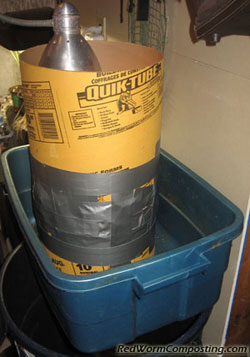
I originally planned to use some sort of PVC piping, but in the end I opted for a cheaper and more readily available option. I am using a 10″ diameter reinforced cardboard cylinder, intended to be used as a mold for concrete post foundations (for decks, fences etc).

The screen is a fairly heavy guage 1/3″ metal mesh – essentially like a heavy duty chicken wire. It works well because it is strong enough to hold a decent amount of compost, but flexible enough that I was able to create reinforcement tabs that were pressed up against the outer wall of the tube.

Basically, the harvesting tube consists of two pieces of the cardboard tube, with a screen floor in between. The upper section is about 1 ft in height while the lower section is somewhat less. The supplies for the system cost about $20 (including the price of the duct tape used to secure everything – hehe), and that would be enough for 2 or 3 of these harvesting tubes – so pretty inexpensive!


Like any good pseudo handyman, I relied heavily on duct tape to put the system together.

While it WAS incredibly easy to put together this system, when it comes down to it, the big question is whether or not this thing is even going to work for me!
I decided to start testing it out using some bulky material (and worms) from my European Nightcrawler Worm Inn system.
There is a fair amount of vermicompost in the mix, but also a considerable quantity of unprocessed materials as well. Due to the moist, bulky, and generally inconsistent nature of this bedding, it would likely be a real pain to harvest worms from using traditional methods, so I felt that it was a prime opportunity to put the SSUBWHT to the test!
😎

For my initial test I added approx. 3 lbs of bedding/worms (with extra worms included for good measure) over the screen floor, then positioned the lamp head directly inside the tube. While I use mostly fluorescent bulbs around the house, this particular light (occasionally used in my ‘worm room’ for various tasks) actually has a 60 watt incandescent bulb. If you really wanted to drive the worms down quickly, an actual heat lamp might not be a bad idea (although, in that case your tube should be made of something heat resistant).

As you can see in the image at the beginning of this post, the tube was positioned in a Rubbermaid tub. The lowermost compartment is simply positioned over top of a heap of moistened brown paper to provide shelter for the worms once they go down.
So how did this puppy perform?!
My initial attempt with the harvester proved to be ineffective, although it would be a great way to collect mites – WOW!
😆
My suspicion is that A) I didn’t leave the light on long enough, and B) there is too much light getting in to the lower compartment (so it’s not a very tempting retreat). This morning I made a plastic skirt for the tube (using a garbage bag) which basically slides down and completely covers the tub. I turned the light on again about an hour and a half ago, so we’ll see if that helps.

[…crickets chirping…]
Ok, I’m back!
Well, it looks like I still have more work to do. Again, I’m seeing LOTS of other compost critters down below (mites, springtails etc), and the worms ARE moving downward – but they still aren’t going into the lower compartment.
Just remember, Edison discovered thousands of ways NOT to make the lightbulb before he finally figured it out!
😆
I’ll keep you posted!
**For Even More Worm Fun, Sign Up for the RWC E-mail List!**
One thing I forgot to mention…
This approach is intended as a means of completely separating the worms from the material. I suspect that if you simply wanted to move your worms to a new system it would be a lot easier, since the ‘stuff’ down below the screen would be a lot more tempting than wet paper.
Speaking of wet paper, I’m also wondering if it would help to add enough so that it actually makes contact with the screen? Hmmm…
Don’t mind me – just thinking out loud here.
😆
Worms don’t much like bedding that’s infested with a lot of mites and springtails. Some seem to be OK (and unavoidable) but a lot of them seem to “bug” them 🙂
I have some experience with vermicomposting but I got this information about mites, etc from the book “Worms Eat My Garbage” by Mary Appelhof (1982). Pages 62 – 63 Don’t know if Mary’s book is still available, but it makes for very interesting reading if you can get your hands on a copy.
Hi Bentley,
I think the problem is that worms don’t like to ‘jump’. I mean leave to the place with no bedding.
Is it possible to make your cardboard touch the screen from below?
Thanks Kaye – that is an interesting notion. I have never seen evidence of this myself. As I’ve written on the blog, I find that a very diverse compost ecosystem has important benefits. That being said – it all depends on the type of system you are using. The closed plastic tub systems are a bit more unforgiving than open or enclosed wooden systems. Still, my argument is that it is the conditions that result in the abundance of certain organisms – not the organisms themselves – that is usually the issue for the worms.
I actually sell the 2nd edition “Worms Eat My Garbage” (via my Canadian worm business), so I do have the odd copy lying around.
😉
Edward – I think you have hit the nail on the head – this is something my dad and I were discussing as well! My next test will definitely involve having material flush up against the screen.
Thanks for sharing your thoughts!
Your system reminds me of the cat box for our Miss Kitty it has holes in the bottom about 1/2 inch square and two boxes below that are solid kinda the same theory but yours is cuter.
The subject of vermicomposting came up on my gardening forum and someone posted a link to your website. I’ve been reading your articles and watching videos for a couple hours now. I’ve never done this before but I think I’d agree with your comment, this would work better if you were just starting a new bin.
You could just use the top half with the screen attached and support it in the bedding of a fresh bin. Shielding the bin from the light might help too.
I’m planning to start my first bin this year and try some of your other ideas also. I really like the trench idea.
Hi Wayne,
Thanks for stopping by. Your advice definitely has some merit. I’ve continued to test this method out, and unfortunately it’s just not producing the desired results. I still plan to try using aged manure to lure them down, but I think for the most part this isn’t going to be a viable harvesting method.
Live and learn, I guess!
🙂
In another post on my forum a link was posted to the University of Nebraska. Towards the bottome of the article was another link to a site talking about using the ‘Onion Bag Method of Harvesting’. This one is on cityfarmer.org.
The method sounded pretty interesting although I have doubts on how thoroghly it would harvest your worms.
Hi Wayne,
The onion bag method and my ‘garbage bag method’ (both very similar in principle) are good for getting most of the worms separated from the vermicompost – but not really great for actually harvesting worms. They are better for transferring worms to a new system. Unfortunately, the SSUBWHT seems to be similar in its abilities (ie not great for actually harvesting worms).
I think I’ll just make a rotating screen harvester with the rest of my tube and screening material.
😆
GrowingPower.org uses a pretty simple concept for harvesting. They place a screen on top of the bin and then spread food on top of the screen. As the worms migrate up, they periodically empty the screens contents into a new bin. Although they readily admit that they lose 20% in this manner. Since they seem to have upwards of 50 bins with 50 – 80 lbs of worms in each, 20% to them is probably an o.k. margin of error. It would likely be impossible to separate 95-99% of the worms in those kinds of volumes.
I think you are on the right track here Bentley. Last summer, I observed something interesting while trying to separate my worms from the vermicompost. It was hot/sunny outside, so I dumped all my bins out into a single huge pile on a big tarp. Of course the worms did not like the light/heat, so they would migrate deeper in the pile. Then, every hour or two, I would go scrape away a layer of outside material (a few inches) until I started hitting worms. Rinse, repeat…. until finally the pile was reduced to almost nothing (perhaps a few cubic feet). At that point I really started wondering, “where the heck did all my worms go?” But then I stuck my hand into the center of the pile, and found out! There was literally a HUGE concentrated mass of pure worms right in the center of the remaining material…in something of a ‘ball’. It felt pretty weird! Just like sticking your hand into cooked spaghetti… except it was ALIVE!
Anyway, all that is to say, I think this light/heat ‘herding’ has merit. Just brainstorming here, but with my outside sun light/heat approach, I wonder if I placed/buried some sort of a perforated or screen container (filled with worm-friendly material, something cool like damp shredded newspaper) at the center of my pile, then used the same approach of removing outside layers until the worms eventually were forced to the center of the pile, into the container. I’d have de-wormed compost outside the container, and pure worms inside the container (of course there would still be cocoons in the outer compost – another potential challenge).
Fascinating! My grandchildren and I are studying worms in school. Won’t they be intrigued to see and read all this. Thank you for the interesting information!
Hi! How about putting the worm-containing compost in some kind of a bucket, say, 2/3 full, then fit a metal mesh pressed agains the top of the compost. Then you slowly fill the bucket with water, the worms escapes the water flood through the mesh, and before long you will have all the worms above the mesh.. and they will be washed, too :)!
By the way Bentley….found 2000 ways not to make a light blub….so you have a way to go to catch up to him(haha)…so go luck with that…
Happy Worm Time!!!!
Grady
PS It Worm time some where in the world so enjoy it.
And I was trying to say Edison….I think I am drunk type without a drink which is sad(hahaha)
Grady
This worked for me and is similar to what you are trying to do.
I built a little square box with hardware cloth attached to the bottom. This box was a bit smaller than my tub, allowing it to lay directly on top of my new week-old prepared tub. Then a clamp light with a 60W bulb was attached to the box and sat 3-4 inches from the compost. The worms dropped down and I was also able to save the cocoons. The cocoon “picking” took a bit but I was amazed how many there were. My only concern was that the cocoons may not have survived because the compost remaining in the box was fairly dried out. I don’t know how sensitive cocoons are. Am I wasting my time doing this?
Hi Bentley,
I want to know how to harvest my gold dark from my plastic bins.
What I get is gooey dark stuff. with worms in it… it takes a long time to separate them – It is a big project and I dont mind, but I know there are other ways to do it, can you pls. tell me? I want to change for a simpler system than the plastic bins. Do you have a video to show how to harvest? I have been putting the gooey stuff on my plants they look like they like it.
Please HELP, sometimes I am feeling not good enough to take care of my worms :(((
thank you!
Charu