
July 30, 2009
Worm Bed Potato Gardens – Update

The potato plants are thriving in this vermicomposting bed
One month ago I wrote about some experimental grow boxes I had set up to see how well potatoes and bush beans would thrive in an active worm composting system (see ‘Worm Bed Potato Gardens‘). I was initially a little pessimistic about my chances of success, since unlike the vermicomposting trenches – which are essentially separated from the actual main plant growth zone – the potatoes would actually be growing right in the composting mass. My worry was that the volume of material in the bin would not only continue to decrease, but would also be unstable in general – due to all the activity of the worms down below.
In all honesty, the bush beans have not really thrived at all. My suspicion is that this has something to with the fact that, as legumes, these plants rely on a symbiotic relationship with Rhyzobium sp – the specialized group of bacteria that help them fix nitrogen. Given the fact that there is no soil in these boxes, and that it is a microbially-competitive environment (likely favoring those species adapted for life in a compost heap), it’s not really all that much of a surprise. Interestingly enough, aside from showing fairly poor growth, the bean plants have been quite yellow in color – often an indication that a plant is deficient in nitrogen. I did attempt to inoculate the plants with some soil (and plants) from patch of Black Medic (Medicago lupulina) – another legume – growing in my lawn, and it actually seemed to work (it worked very well in some other bean grow boxes I will write about in another post). I think it was simply a matter of being too little too late however.
As for the potatoes…
One look at the picture above should tell you just how well they are doing! I am starting to think this method may actually be a REALLY great way to grow potatoes! Of course, the real test will be to see how the potatoes look once it is harvesting time, but I’m certainly feeling optimistic! One or two people mentioned (in comments after the last potato post) the fact that it actually helps to continue mounding up material around the stem of the potato plant as it is growing, since this can lead to the formation of more tubers. As such, all the sinking and layering of materials taking place in these boxes may actually be exactly what these plants need to produce more spuds.
Essentially, what I’ve been doing is adding aged horse manure then covering it with straw. Once the level sinks noticeably, I add more manure (on top of the straw), along with a new layer of straw over top.
Aside from seeing how the potatoes would grow, I also obviously wanted to see how well the system would function as a worm bin. Initially, I was a little worried that the worm habitat would overheat by sitting out in the sun all day long. I’m sure our relatively cool summer has helped, but in all honesty I think my fears were unfounded. The worms seem to be doing extremely well, especially now that they have a nice canopy of foliage to shade the bin.
All in all, I am super excited about the results of this experiment since it has far exceeded my expectations…so far!
Stay tuned. More updates on the way (I will write more about my other vermi-gardens as well)
8)
Dryer Lint Worm Bin – Update #3
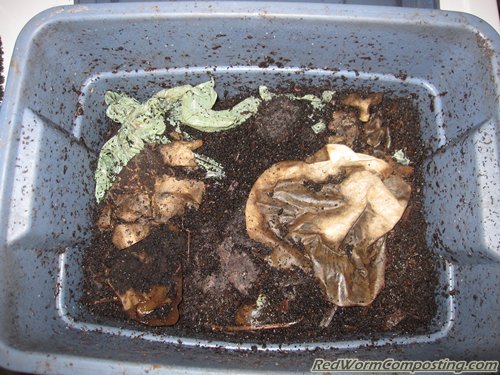
It has been a very long time (almost two months) since my last dryer lint worm bin update, so I figured I should check on the bin the other day to see how things are shaping up. It’s funny – a lot of people seem to stress out about making sure they don’t starve their worms, but the fact of the matter is that it is a LOT harder than you might think. I have tested this (without really thinking about it too much – haha) on many occasions – this lint bin being a prime example. Apart from the food that was added when the bin was set up initially (at the beginning of April), and the odd batch of coffee grounds since then (I think I’ve added about three coffee filters with grounds), this bin has received nothing in the way of inputs – yet the worm population seems to be thriving.
When I last wrote an update, it looked as though most of the lint was still intact. Well, it definitely looks like a lot more of it has decomposed now! There didn’t seem to be much in the upper few inches of the bin that looked like lint. Further down in the bin was a different story however – near the bottom on the bin I found layers of wet, compacted lint that looked as though it hadn’t undergone much decomposition at all.

Much of the original lint seems to have been converted to rich vermicompost
This is not surprising at all – I have seen this many times in plastic tub worm bins, and it is almost certainly due to the lack of oxygenation in the lower reaches of the bin (I don’t have holes down there).
All in all, I must say that I’m pretty impressed with lint as a worm bin bedding material. I think it would be especially valuable in a bin that also contains other bedding such as shredded cardboard, since it provides a bit more of a wet ‘habitat’ zone, while the cardboard etc would be valuable for soaking up moisture and more quickly balancing the C:N ratio in the bin. I think the next step will be to test this on a larger scale – perhaps I will try adding a bunch of lint to my big outdoor bin, or my trenches.
Anyway – I will certainly keep every one posted!
8)
Previous Dryer Lint Vermicomposting Posts (oldest to newest)
Composting Dryer Lint
Composting Dryer Lint – Update #1
Dryer Lint Worm Bin
Dryer Lint Worm Bin – Update
Dryer Lint Worm Bin – Update #2